 Skip to content

From Uniforms to Streetwear: How Patches Crossed Into Mainstream Fashion
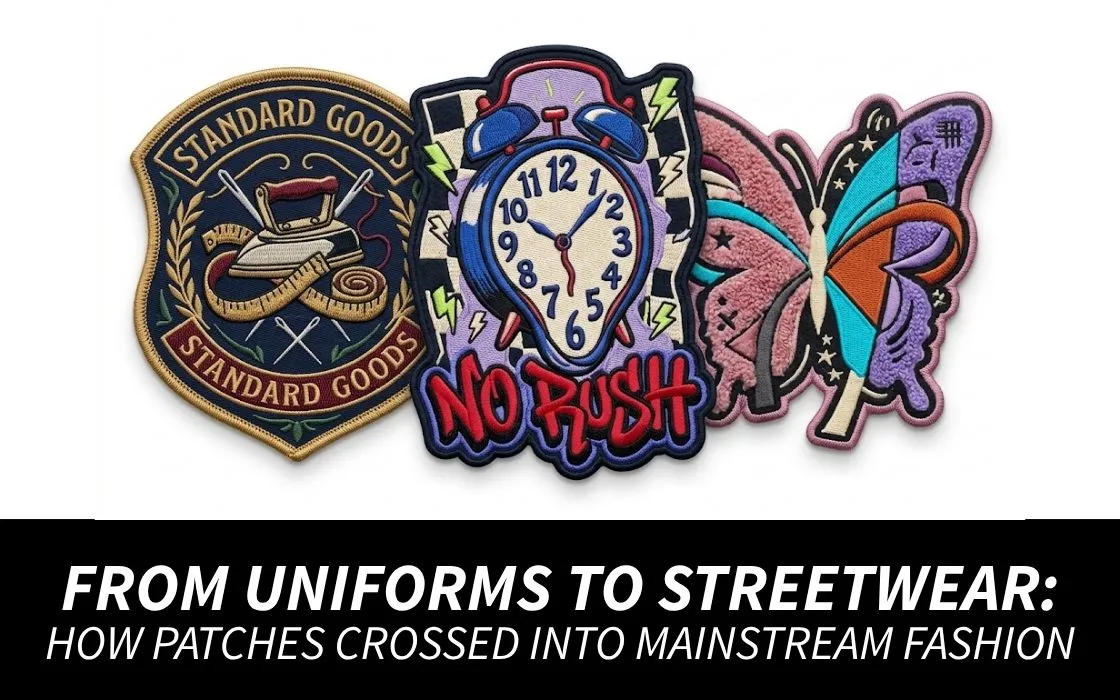
Custom patches may appear as a simple piece of cloth but they can entirely change the appearance of a coat, trousers, or a handbag.
Patches are worn on denim jackets, varsity jackets, caps, bags, hoodies, or street style wear. Some embroidered patches may have some band names while others may have various other symbols such as names, jokes, designs, colors.
However, patches are not a fashion accessory from the start.
Their history began with custom patches being part of uniform and then it started moving from job wear to other things in life like youth culture, music, street fashion, or even high fashion.
Now the question is how something which was used for identification of groups can now be such a part of our usual clothing.

Patches Started With Uniforms
Military uniforms have contributed in creating one of the earliest and the most easily recognizable applications of the embroidered patches.
Military personnel had the need for some clear symbols that could convey their group without having to ask them whom they belonged to. The symbol soon became a major element in the military uniforms and had different designs, colors, and signs.
Later schools, sports teams, clubs, organizations, and other groups started using embroidered patches to convey membership, achievements, or affiliation.
The concept is simple; just one design was enough to say a lot without saying anything at all.
This aspect would prove extremely helpful in patch application among young people’s fashions.
Denim Gave Patches a New Life
One of the most obvious materials that was ideal for patching is denim due to durability and ease of wearing the clothes again and again.
As Levi Strauss & Co. reports, their jeans were customized by their users for many decades.
The firm describes its early jeans as “a blank canvas for functionality and later, a hotbed of creativity”, implying that the jeans transformed from practical wear into personalized wear.
There is one example that stands out. Doug Hansen bought a pair of Levi’s 501 jeans in the 1970s and patched them using iron-on patches when the jeans split at the seams.
However, he did not limit himself to only patching the worn-out jeans.
He started adding fabric, artwork, lettering, and so on until his jeans became an expression of artistry.
When looking back, he said that “My appearance was important.”
This shows the change that took place: patching could be just covering of damaged places, but it could also become part of design.
The 1960s and 1970s Made Custom Clothing More Personal
Youth culture made decorated clothing much more prominent in the 1960s and 1970s. People taking part in counter-culture started to change normal clothes rather than just wear them as they have been made. Denim became a good material for sewing, coloring, and adding embroidered patches.
Levi Strauss & Co. notes that young people in the 1960s counterculture movement embraced clothing customization and began changing their clothes in more creative ways. The reason for its popularity is clear: it was possible to buy a cheap jacket and, with the help of some fashionable decorations, to make this jacket look like no other.
This idea also helped to give the second life to old clothes instead of throwing them away each time they became torn or shabby.
Streetwear Helped Bring Patches Into Everyday Fashion
The streetwear subculture picked up ideas from earlier events of youth culture, including extra-large looks, artistic graphics, references to sports, workwear, military elements, and DIY decorations.
As patches helped to achieve various effects while still keeping the general silhouette of the garment intact, they fit perfectly into this creative process. A plain coat can keep its simplicity while a few embroidered patches give it a completely new appearance.
Companies can use custom patches to present logos, people, and illustrations without redesigning the whole piece of clothing.

Fashion Designers Put Patches on the Runway
The next major step came when luxury designers began treating patchwork and embroidery as serious design elements.
Gucci offers a clear example. The brand has explained that creative director Alessandro Michele wanted a patched denim jacket for a trip to Los Angeles, so he hand-stitched one himself before traveling.
That personal experiment eventually became the inspiration for a Gucci collection featuring patched denim with embroidered butterflies, flowers, snakes, tigers, and other motifs.
The story is interesting because the idea did not begin with a large production plan. It started with someone wanting to change a jacket and making the changes himself.
That same instinct still drives much of patch culture today.
Why Do Patches Still Work So Well?
Custom patches are capable of:
- Fixing a damaged or worn-out section.
- Adding some color into a plain outfit.
- Having the ability to express one’s affinity towards a band, team, club, or cause.
- Transforming an ordinary jacket into an individual item.
- Introducing texture without altering the original design of clothing.
- Making old clothes look renewed.
From Repair Work to Fashion Statement
Embroidered patches can be described as the evolution of clothing due to the way people put an interesting new use into ordinary clothing.
A military patch can show the number of the unit. A repair patch can save a pair of jeans. A punk jacket can show the bands favorite for someone. A designer jacket can also use that idea but in the luxury area.
The meaning gets changed but the original appeal stays the same: a patch allows one to change the piece of clothing without changing the whole thing completely.
Today it is especially a good idea since people are more inclined towards clothes that carry some input from the personal side rather than being absolutely uniform.
How Can You Wear Patches Today?
For an easy combination, put one large patch on the back of a denim jacket or a few smaller patches over the chest. To get a more die-hard style, combine different shapes and structures all over the front, sleeves, or back.
It’s also possible to style patches according to something you like, like music, sport, travel, your hobbies, or something else.
The best design should always look smooth rather than overcrowded. Start off with one or two patches, see how they look on the jacket, and add more patches only if necessary!
FAQs
Why did people put patches on denim?
The embroidered patches were put on denims in the past to fix worn parts. Denim became useful not only for repairing clothes but also for adding creative designs.
Why are patches associated with punk fashion?
The punk community uses patches on denim and leather jackets to put band logos, artistic images, and slogans representing the taste of music and culture.
Are patches still popular in streetwear?
Yes. Designers and various brands use embroidery and fabric patches in streetwear, such as jackets, bags, caps, and hoodies.
Can patches make old clothing look new?
It is possible as custom patches can change the look of an old garment and at the same time fix some worn-out parts of it.