 Skip to content
Durable Emergency Services Patches: Built for First Responders & Tactical Use
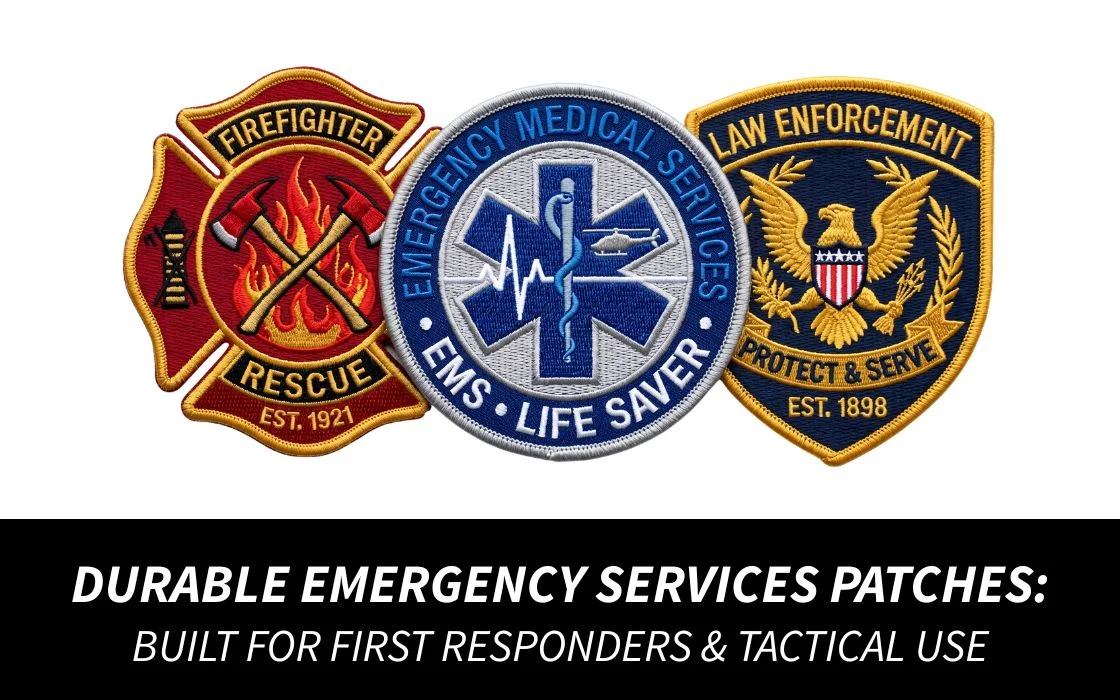
In 2026, emergency services patches changed from being simple identifiers stitched to uniforms to being one of the most crucial features of modern-day tactical uniforms.
When first responders are performing their jobs nowadays, they operate in faster and more delicate environments than ever before. The ability to identify and coordinate quickly greatly impacts how successfully they will achieve their goals.
This also means that durability alone is no longer the main goal. Patches now need to provide strength, high visibility, and some digital features, all at one go!
As firefighter units and tactical rescue teams move toward adopting smarter and more adaptive patch solutions, the demand for innovative ideas is even higher now.
This guide provides information on how emergency services patches have grown through 2026 according to new materials; smart integrations; and design trends.

2026 Trend: Rise of Smart & Tech-Integrated Patches
One of the key advancements we’ve seen currently is more use of smart emergency service patches. These don’t just allow to recognize people via static fabric, they also provide a better way of connecting resources in the field.
Specifically, the integration of RFID and NFC technology into these fabric identifiers provide quick tracking and staff identification.
QR-coded patches are becoming the norm for quick scanning so it becomes convenient to quickly access workers’ personal documents, medical history, or roles.
Moreover, the implementation of QR codes results in less confusion and faster decision-making, especially during large-scale emergencies.
Military and disaster relief agencies are often the first to use these types of technologies.
The shift towards using smart emergency service patches will turn an old-school fabric identifier into a real-time data point.
Advanced Materials Revolution: Beyond Fabric and Thread
Material Type | Key Characteristics | Why Does It Matter in 2026? |
PVC | Water-resistant, flexible & thermal resilient | Best suited for high-stress environments (i.e. fire and rescue) |
Silicone-based Materials | Soft, strong, and chemically resistant | Used by hazardous materials response teams and medical emergency personnel |
Hybrid Composite Fabrics | Composed of two layers of textile and polymers | Combination of durability and flexibility provides comfort |
Flame-Resistant Fabrics | Resistant to ignition and exposure to heat | Important to firefighting and high heat operations |
Anti-Microbial Coatings | Minimizing risk of bacteria and contamination | Hospital based and emergency nurse response teams |
UV & Weather-Resistant Coatings | Protects against UV damage and fading | Increase long term visibility in outdoor projects |
Visibility First: Reflective, Infrared & Night-Ready Designs
In 2026, emergency services patches are one of the top priorities within design.
Many first responders perform their duties within a variety of areas that can have very limited light sources to no light sources at all.
To have more visibility while performing active operations, reflective stitching and high-contrast colour combinations have become quite common.
Infrared (IR) reflective patches are starting to gain popularity in tactical response units for carrying out responses to incoming tasks.
With a reflective IR patch, tactical responders become clear with a night-vision device.
Glow-in-the-dark materials are being revised for longer-term usage post-disaster recovery, where the loss of lighting in a disaster recovery situation could remain in effect for some time.
Advancements in these areas of research will ensure that emergency staff workers are able to be known by the emergency responders experiencing a great variety of environments.
Modular Uniform Systems: Why Velcro is Dominating in 2026?
New modular uniform systems are being set up in the modern emergency service, with Velcro-backed patches leading the trend.
Velcro patches have many advantages over traditional sewn designs. It includes ease of removal, replacement, and reconfiguration that allow responders to immediately adjust to functional needs.
Multi-role environments require the same responder to perform several functions. It could be a single responder that may require speedy change over between any combination of rescue, fire suppression, or medical support.
This provides efficiency through a reduction in downtime and increased cost-effectiveness for agencies managing many personnel,
By 2026, modular designs will not just be the most in demand and trendy; they will be the foundation of all contemporary emergency service environments.
Personalization Meets Standardization: A New Balance
Emergency Service Agencies face the challenge of balancing two opposing aspects:
Personalisation vs. Standardization.
While signage and rank structures continue to be very strictly monitored, there is growing acceptance of controlled personalisation via moral patches/unit identifiers.
By using digital design libraries, agencies can keep their designs consistent.
This will ensure each unit remains constant with brand and identification standards, as well as following compliance measures.
In addition, personalization can also improve team morale and identity in highly stressful situations.
However, strict guidelines must also be put in place to ensure that personalizing any item does not impact authority recognition on the street.
AI-Driven Design & Faster Production Cycles
The design of emergency services patches is undergoing rapid change due to the implementation of artificial intelligence (AI) technology.
AI-powered software now allows department personnel to create accurate design prototypes immediately based on their requirements.
The use of automated systems will also smooth out workflows for manufacturers and result in quicker production times for both small (<100 patches) or larger quantity (100+ patches) orders.
Real-World Use Cases: How Modern Patches Improve Field Efficiency?
Case Study: Regional Emergency Response Coordination Upgrade (EU-Based Multi-Agency System)
An emergency management authority in Europe struggled with slow identification of personnel and delays in coordination between many agencies for years.
Identified Problems
- Confusion in identifying personnel roles by each agency
- Delays in assigning agency responsibilities during drills
- Lack of visibility of team roles in lightly lit or smoke-filled environments
- Command staff using manual verification processes that slow down decision-making
Implemented Solution
The emergency management authority executed a standardized approach to using emergency services patches for workers’ identification. These patches include:
- Color-coded patches for identification of role (fire, EMS, rescue, etc.)
- Reflective stitching for visibility in low light or smoke
- QR-code enabled patches to quickly verify personnel during emergency drills
- A modular Velcro display system for easy switching between roles
Results
- Faster recognition of staff during emergency drills
- Better coordination of all agencies’ responses to many disasters, both big and small
- Great reduction in time for role assignment during command operations
- Better visibility and safety compliance during simulated low-light environments
Key Takeaways
This implementation has proven that today’s emergency services patches are no longer just identifiers.
They now serve as:
- Operational tools
- Play a critical role in defining how quickly an agency can respond to an emergency, coordination accuracy between agencies, and performance of agencies to improve field safety.
Choosing Future-Ready Patches: What Buyers Should Prioritize?
It’s wise to think about the future when buying an emergency services patch in 2026.
Buyers should think about material strength and how well patches can adjust to different kinds of technology in the years to come.
Material quality is still an important thing to think about and should take into account the ability of the patch to withstand heat, weather, and chemicals.
In fact, the emergency services patch should be compatible with modern features such as Velcro systems or reflective elements, and also align with future smart technologies.
The agency needs to consider the capabilities of its suppliers to ensure that they can support the agency’s needs for both small runs and large runs of emergency service patches.
Agency purchasing decisions should also be according to visibility needs, regulatory compliance, and how well the patch will work over time.
An emergency services patch that is future friendly will be a patch that works, reads, and can adapt to changing operational realities, regardless of how long the patch may be in use.
Common Buying Mistakes in 2026
Most of the time, buyers face only minor mistakes.
However, various manufacturers have made larger-scale mistakes when choosing patches. It was basically they chose price over environmentally-friendly patches.
Other manufacturers create and purchase designs without properly planning for future scalability.
There are several OEMs who will order designs that are not easily able to be standardized across different teams.
Many of these mistakes lead to higher long-term costs and operational efficiencies.

The Future of Emergency Services Patches: What’s Coming Next?
In the next 5-8 years, the primary focus of the development of patches will be heavily directed toward connectivity, and integration.
- It is because of biometric connectivity standards.
- The use of real time tracking of patches to provide situational awareness for first responders during large-scale incidents via dashboard installations.
- The smart uniforms of the future will add-on the patch as part of an integrated, fully connected ecosystem.
As a result of these, the common perception of how first responders are tracked, and coordinated in the field is changing from a growing recognition marker to a data enabled asset.
Conclusion: From Identity to Intelligence
In 2026, patches used by emergency services have evolved from a tradition of identifying personnel and units via simple identifiers into an intelligent, multi-functional system of interconnected devices.
Organisations that implement solutions designed for the future will receive more than just products. They will also receive adaptable capabilities to meet the changing dynamics of emergency response.
With continuous technological advances, the use of patches will grow into a fully connected and data-driven system.
By investing in patches for use by emergency service personnel today, you will be facilitating future requirements that will surely be in demand!