 Skip to content
Custom Patches for Clothes: From Fashion Statements to Branding Tools
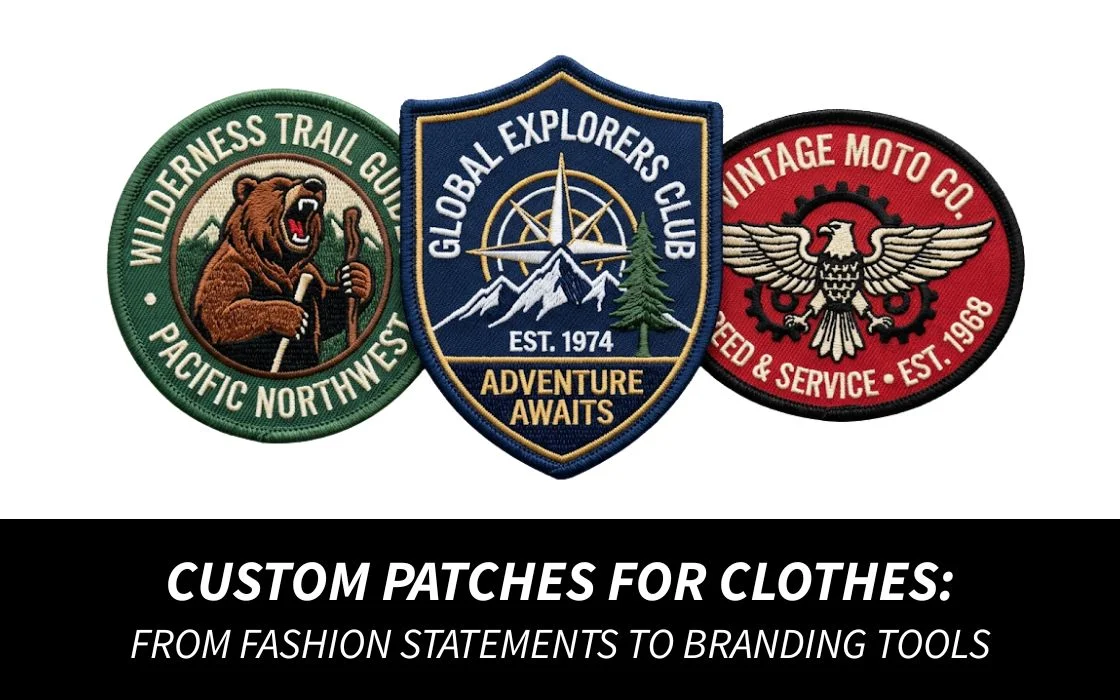
Personalization is going to define the way we do fashion & branding in 2026 and beyond.
In a world where we all want to be unique, it’s shown that custom patches are one of the easiest ways to create uniqueness.
At one time, patches were used for decoration but they now have become a medium through which people can communicate their identity/tell a story.
What Buyers Really Look for in Custom Patches?
Custom patches for clothes can now be found in various ways including; streetwear, corporate uniforms, military wear, and event merchandise, etc.
They are being used as more than just design elements, but as a strategic tool for branding.
Custom patches for clothes have a distinct aesthetic, durability, and flexibility as well as having a strong visual impact. They can be used in both personal and business settings.

Types of Custom Patches for Clothes Explained
There are different types of patches.
- The most traditional (and biggest) patch type is the embroidered patch. It has a textured feel, durable construction and is appropriate for uniform applications as well as classic branding.
- The woven patch offers a much finer detailing than the embroidered patch and will have a much smoother surface. It is great for intricate logo designs and/or small text.
- The PVC patch has a modern waterproof application and is most often used on outdoor products and tactical equipment.
- The printed patch allows for the highest resolution images/graphics/designs with complex art and/or gradients used in the production of the patch.
- The chenille patch, commonly found on baseball jackets, provides a bold raised texture that makes it very visible.
By choosing the correct patch type to use, you can achieve the desired functional and aesthetic use.
Patch Backing & Attachment Methods
How a patch is secured to its backing is equally as significant as the patch itself. As for an iron-on patch, it’s easy and fast to use for informal applications.
A sew-on patch is used in uniforms or high wear for durability.
Further, Velcro (hook-and-loop) offers flexibility since they can be removed/changed at any time.
Finally, an adhesive (glue) backing is useful for short-term applications such as event graphics or labels.
Selecting an incorrect attachment will cause a patch to be prematurely attached, resulting in inconvenience.
Picking the correct backing type for the suitable use will extend the lifespan of the piece and allow for ease of use when attached.
From Fashion to Function: How Custom Patches for Clothes Are Used Today?
Beyond just sitting on a piece of clothing or gear, custom patches are now being used for both creative and functional applications.
The use of patches in both fashion and streetwear has opened up many opportunities for personal expression and limited-edition designs.
Brands utilize patches to create exclusivity and identity.
Patches are also found on uniforms for corporate branding purposes as they help promote brand awareness and professionalism.
They have also been used by events and communities, such as clubs, sports teams, and organizations, as a way to create belonging and recognition.
Finally, patches serve a practical purpose in military/tactical environments through identification and morale-building.
The versatility of a patch makes it one of the most flexible forms of brand and design application available today.
Branding Power: Why Businesses Are Investing in Custom Patches?
Businesses can gain exposure to their brand for an extended period of time through the use of custom patches for clothes.
Unlike a digital ad that is only displayed temporarily (for a short period of time), patches are visible for an extended period of time (e.g., on a jacket or backpack).
They can act as mobile brand marketing tools.
In addition to being effective, patches are also very cost-efficient.
A single patch can continuously generate brand impressions for a business without the need for a business to re-invest in advertising.
Patches can be used on employees’ uniforms or on promotional items to help companies establish a physical connection with their target audience and increase brand loyalty over time.
Design Considerations That Impact Quality & Cost
Well designed patches should be both visually appealing and functional.
There are several factors to take into consideration when producing a patch including; thread count, stitch density, limitations on color, and patch size.
In addition, borders (whether mowed or laser-cut) will also influence durability and finishing.
If you select a complex design, it might give rise to more costs.
With a smart design, the patch will be more attractive to look at, stay longer, and remain within your budget.
Production & Ordering Process
Bulk purchasers must be aware of the production process.
The production process starts with design submission, followed by digitalization or converting the design into production-ready format.
Once the electronic design is ready, a sample will be created in the patch well-thought of for purchase. It is important to approve it before actually producing it.
Lead times may vary based on the size and complexity of the order. However, there will be many check points to validate the quality of the product.
For businesses, the structured approach to the production process allows for predictable and consistent end results at the bulk levels.
Sustainability & Material Trends in 2026
A lot of customers now prefer sustainability to making a purchasing decision. Be it a custom patch, they look for sustainable product options.
Recycled threads, eco-friendly fabrics, and ethical manufacturing practices are the current criterias before making a purchase.
Patch options that meet a customer’s desired sustainability level without a reduction in quality or durability will continue to excel and be the reason to trust.
ROI of Custom Patches for Branding (With Practical Metrics)
Custom patches are providing valuable returns. They provide the lowest cost per impression when compared to other marketing methods, due to their long-life span.
With each use of a custom patch, there is a greater degree of brand exposure than with most branded merchandise. This makes them a highly effective branding medium.
For businesses custom patches provide maximum visibility at a very low cost after initial investment.
Common Mistakes to Avoid When Ordering Custom Patches
- Not Considering Backing Options
- Making Patch Design Complicated
- Not Thinking About Patch Use

To create high quality custom patches for clothes, you need expert knowledge of materials, designs and methods of doing the work.
Reliable methods of producing patches and strict methods of checking the quality are a must to have each patch backed with consistency, durability and a professional look.
Conclusion: From Decoration to Strategic Branding Tool
In today’s world, custom patches are no longer just decoration; they’re a tool for identity, branding and communicating.
With a good patch design and a properly selected type of patch, you give them long-term value and offer a unique combination of style and functionality that other branding tools simply cannot provide.
So, are you ready to create patches based on your ideas?
Check out the various types of custom patches of clothes available today and find a style that fits your brand or team or is personal to you!