 Skip to content
Leather Patches for Small-Batch Product Launches: What to Consider Before Ordering?
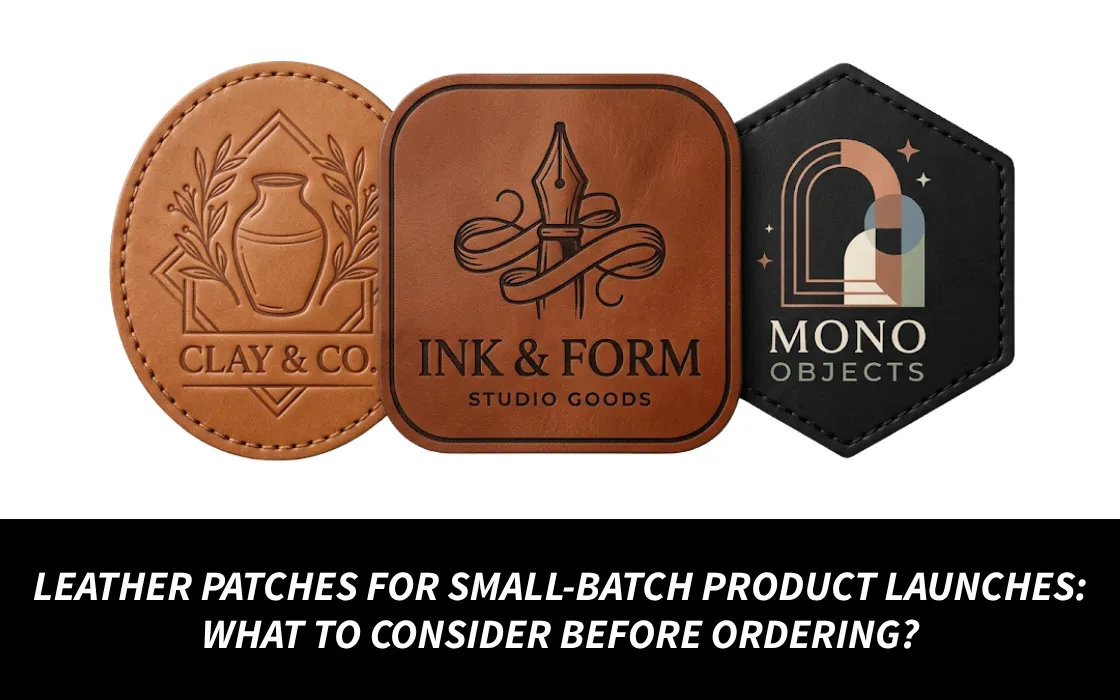
Opening a small line of clothes or accessories is an exciting activity. However, choosing the right custom components can prove to be tough. For instance, leather logos can ensure that you give your product a clean and high-end look without the need to alter the design entirely. You can use leather patches on hats, jackets, jeans, bags, hoodies, and many more products to identify your logo or brand name. For example, here are some things you have to consider before ordering: fabric, quantity of patches, its minimum order and size, sample price and quality.
Quick Tip: If this is the first time you launch your product, always place a sample order first.

Why Use Leather Patches for a Small Product Launch?
Leather patches come in handy to improve the look of a basic product.
For example, take a small apparel label that launches only 50 denim jackets. Rather than print a big logo on every individual jacket, one might add a leather patch with its logo on it.
That gives a sophisticated and simple impression, without making the jacket too bulky.
You can use the same small leather patch on:
- Leather patch on jackets
- Leather patch on a cap
- Leather patch on a backpack
- Leather patch on a beanie
- Leather patch on a hoody
This way it will be easier for consumers to identify the products of this brand.
Choose the Right Leather Material
Before ordering, ask the supplier exactly what material they use.
You will usually come across real leather and synthetic leather, such as PU.
Features | Real Leather | PU Leather |
Material | Animal leather | Man-made material |
Look | Natural | More even |
Feel | Natural and soft | More consistent |
Price | Usually higher | Usually lower |
Best For | Premium or classic brands | Consistent, lower-cost products |
Genuine leather has a nice color and texture from patch to patch and gives each patch a ‘natural’ look. PU leather provides you with a more uniform look across the patches.
If your brand does not use animal products, pick the right synthetic choice and ask about the exact material used by the supplier. Don’t pick real leather just because it sounds more premium. Choose the material that matches more with your product and the needs of your consumers.
Check the Minimum Order Quantity
The MOQ (Minimum Order Quantity) is defined as the least number of patches that a vendor will produce for one order. This is crucial, especially when introducing a small range of clothes. Some suppliers require 50, 100, 500, or even 1,000 patches, while others offer leather patch no minimum options for customers who only need a few pieces.
For instance, there are some suppliers who allow the minimum orders of 1 patch, while there are others that require at least 50 orders for some types of custom patches. Hence, do not think that any vendor will provide you with a small order. So you should always ask the following questions before you place an order:
- What is the minimum order?
- Is there a minimum order requirement per design?
- Is it per color?
- Is it possible to mix different designs?
- Will the price change depending on the order?
Always Order a Sample First
Digital designs might be appealing on the computer screen. However, they may differ greatly in reality. If you are unsure about the final design, a leather patch no minimum option can make it easier to order a few samples before committing to a larger batch.
- Color
- Size
- Thickness
- Quality of the leather
- Details of the logo
- Edges
- Back side
- Overall look
Finally, compare the patch to the product. In one case, a computer design for a patch may seem very visible when applied on caps that are much smaller. In another case, a patch applied on a coat may stand out too much when placed on a black backpack. Therefore, always check the patch against the product before ordering more.

Choose the Right Patch Design
Be sure to keep your first patch design simple. For smaller leather patches, the most effective designs will have a clear logo, the short text, simple shapes as well as the clear details. When it comes to very small letters or photographs in detail, they will not look clear if the patch has been reduced in size.
Some common techniques for patch manufacture include:
- Laser engraving
- Embossing
- Debossing
- Printing
- Embroidery applied on leather
Make sure to check with your supplier regarding the most effective method depending on your logo and patch size.
If your logo contains fine details, always send the artwork to the supplier in advance so that they can easily copy the logo without any problem.
Don’t Forget the Backing
The backing enables you to attach your patch to the product. Common backing choices are:
- Sew-On
Here you stitch the patch directly to the product. This is good for jackets, bags, and other items that are used regularly.
- Iron-On
The backing makes use of heat to attach the patch to the product. This is time-saving, but you have to be sure that the product can withstand the heat being used.
- Hook-and-Loop
With this backing, you can detach the patch and substitute it with another one if you want. This backing is very useful for goods for which the customer wants to occupy patches.
- Adhesive
Some patches have an adhesive backing. However, you need to make sure that they are suitable for your product and that they will serve you enough over time.
Calculate the Real Cost
Don’t look only at the price of one patch.
Your total cost may include:
Patch + sample + setup + application + shipping + taxes + packaging
Pricing may vary with the supplier. A supplier currently sells one personalized leather embroidery for $10. A different supplier markets prices that are much lower when ordered in thousands. However, this does not mean that one of the prices is standard. The ultimate price also depends on size, material, design, backing, quantity, and the supplier.
A Simple Ordering Process
The following steps are important before placing an order:
- Prepare the logo and remove the elements that will be too small.
- Define the leather type that matches your business.
- Get quotes from at least three suppliers.
- Make sure you give all of them the same specs so you do not make mistakes while comparing quotes.
- Figure out the minimum quantity that is required.
- Request a proof.
- Ask for a sample.
- Test it on your final product.
- Summarize the total price including delivery fees.
- Keep the approved version for future use.
Example: Launching 50 Jackets
For a small launch of 50 jackets, choosing a supplier that offers leather patch no minimum orders can help you avoid buying hundreds of unused patches. Supplier A offers a minimum quantity of 1,000 patches, whereas Supplier B will sell you as many patches as you require but at a higher rate per patch. Although Supplier A offers a lower price per patch, you will be stuck with an additional 950 patches when your product line is launched. Hence, it makes sense for you to choose Supplier B for your first purchase because you will not be spending any extra money on unnecessary stock.
In Conclusion
Leather patches can offer a different and professional appearance to small product launches. The most affordable patch does not always prove to be the right patch and the most costly option may not always be vital as well.
Pay attention to the important things: good fabric, recognizable design, the right backing option, more than acceptable MOQ, guaranteed quality and easy repeatability of orders.
Also consider the following: try the patch before placing a large order. A few minutes invested into the examination of the patch will save you from a big loss.
The biggest advantage of starting small is that you can check the design without the necessity to order big batches of products. If clients are happy with the result, the orders can be more before moving towards larger supplies.
Want to give your products a premium look without ordering a large quantity? Explore leather patch no minimum options, test your design first, and increase your order once you know what works.